Jamie and Sophie attended their first Bedpost Confessions in January of 2018. Their curiosity was piqued by one of Jamie’s friends, who knew about the blog and suggested there might be some synergy. Not knowing what to expect, Jamie and Sophie wondered if they’d be bored.
Um, no. As they have discussed repeatedly, Jamie and Sophie were blown away by the courage they saw on stage, by the joy and pain revealed, by the feeling of connection to presenters with whom, at least on the surface, they sometimes had little in common. As Jamie said at the time, it felt like they were in a lifeboat with equals, keeping each other safe while heading for shore. It felt like community.
Not to mention the fact that Jamie’s anonymous confession, written on a whim during intermission and added to the stack of cards, was one of the first ones read out loud to the crowd by BPC co-founders and emcees Miranda Wylie and Sadie Smythe. Ah, recognition — the writer’s drug of choice.
Jamie and Sophie attended their second BPC armed with knowledge. They arrived early enough to get better seats. They knew how strong the North Door drinks would be (holy cow!) and to pace themselves. They knew that one of the best things to do at BPC is people watch, and so they indulged.
Jamie spotted her first. He wouldn’t say he has a type, but if he did, she might look like the friendly, petite, silver-haired, tattooed badass he saw across the room. Jamie nudged Sophie and nodded toward the woman, smiling sheepishly. Neither petite nor silver haired, Sophie responded with a knowing grin and a wry eye-roll. Words weren’t necessary; Sophie already knew what catches Jamie’s eye, and in a blog post she has described how, at an event like BPC, even the usual innocent things feel heightened. Besides, she’s got the friendly tattooed badass part covered.
But when that friendly, petite, silver-haired, tattooed badass took the stage, to Jamie and Sophie’s mutual surprise, all idle fantasies went out the window. Spike Gillespie has the keen insight to see the beauty, the humor, the poignancy, and the pain in everyday things, along with the writing talent to bring those everyday things to compelling life. Like Hunter S. Thompson, her narrative default is autobiographical. Like Kinky Friedman, she shines a spotlight on the unique flavor of Texas found in the Austin area. Like Molly Ivins, her mind is a whip that can, with a single flick, separate an ego from its coating of protective bullshit.
Spike’s topic that night was a recently ended toxic relationship from which she is still recovering. Jamie was moved by the raw honesty of her narrative (and maybe a little envious of her mad skills, as creative types can sometimes get). Sophie felt a much more personal connection, having recently ended a toxic relationship herself. All in all, it was another great BPC experience.
Fast forward to January of 2019. Jamie and Sophie were outside during intermission, enjoying a smoke break with the friendly North Door bouncer, whose main job is to tell BPC attendees which door to use. (Helpful hint: It’s in the northside alley.) Jamie noticed that a nearby clump of people included Spike Gillespie, who was having a vape (her “Bilbo Baggins look,” as she later self-deprecatingly called it). Taking this as a nudge from the universe, Jamie reached out via email and began the conversation leading to this interview. Spike helpfully provided background material gleaned from her multitudinous online outlets, including a link to her BPC presentation. Sophie was even more deeply moved by watching it a second time, as the interview questions will show.
Speaking of which, let’s get to them.
Jamie: Let me start with a confession. While doing some BPC research, it dawned on me that I “met” co-founder Julie Gillis more than a decade ago. On a dating site. We figured out we were looking for different things, so it didn’t go anywhere. But it’s fun to say I “almost dated” a BPC co-founder. I reached out to Julie, half-joking that I hoped I hadn’t said anything at the time to stimulate BPC commentary. Thankfully, she cannot recall any #metoo-worthy comments.
How long have you been attending Bedpost Confessions? Was that your first time to present?
Spike: I’m a little embarrassed to say I didn’t make it to my first BPC until summer 2018. My friend Simon was sharing a piece and he invited me as his guest. I was so taken by the readings, by the audience energy, by the whole thing that I was kicking myself for not having attended all the others.
Jamie: We had the exact same reaction: “Why didn’t we do this forever ago?!”
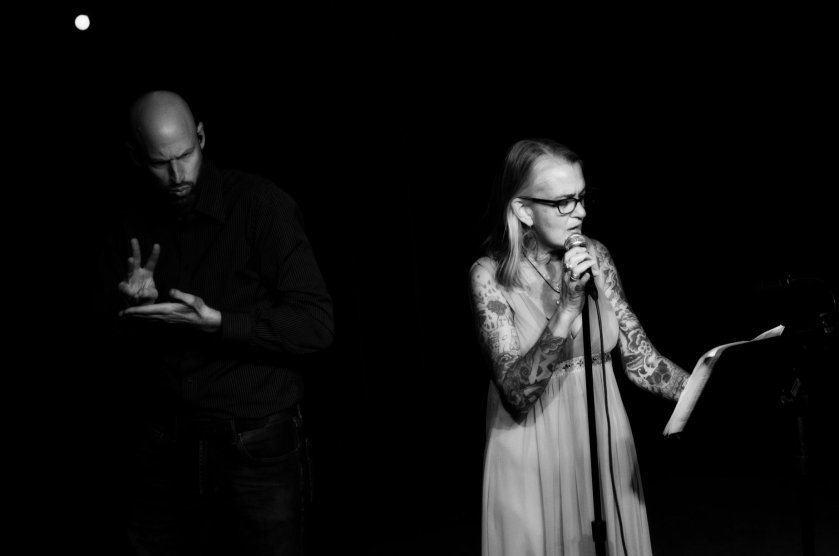
Spike presents, and SOULumination’s Austin Andrews interprets, at Bedpost Confessions on October 19, 2018. Photo by Jack Darling.
Spike: When I presented a few months later, yes, it was my first time. Miranda and Sadie had invited me so many years before, but I think I misunderstood the event, thought the scope was limited and at the time of that invitation I think I said no because I didn’t have anything sexy to share. I’m glad I figured out how broad you can go.
Jamie: The format seems to dovetail well with your narrative style.
Spike: Yes, their format is right up my alley. I often perform first-person pieces that are edgy in shows that I put on at Hyde Park Theatre. Though I did feel a little bit nervous, mostly I felt right at home.
Jamie: You keep a lot of rotating irons in the fire. One of them is Keeping Austin Austin, the sentiments of which (like anybody who’s been here a while) I share. Bedpost Confessions certainly counts as an Austin treasure worthy of promoting and preserving. Any direct connection between the two?
Spike: I think the connection is that both represent what I refer to as Old Austin, a term that surely annoys some people and which doesn’t really have a fixed point on any timeline. To some folks Old Austin might mean the days of the Armadillo Headquarters. To my generation I see the Electric Lounge as a physical location representative of “my” Old Austin. But I hope we all know — I really think this is true — that what the phrase really refers to is a certain kind of attitude and energy that is welcoming, whimsical, and yes, okay, weird even if the term “weird” got totally co-opted. I haven’t posted in Keeping Austin Austin in a long time, but I still put posts up on Facebook whenever I have what counts for me as a classic Austin experience. I have those all the time. I’m talking about hugging my cashier at Wheatsville, walking the streets during SXSW just to people-watch, observing people helping each other without a second thought, endless ridiculous fashion statements, coming across Mariachi bands in the dairy section at HEB, that sort of thing.
Sophie: It took a minute, but eventually I remembered where we might have met before. A few years ago, you officiated a wedding for two of my friends and did an absolutely fabulous job. You definitely brought your unique sensibility to their ceremony. Your wedding officiant work is obviously a labor of love. How did that come about?
Spike: In 2004 I read an article in The New York Times about a growing need for officiants willing to perform non-religious and/or non-traditional and/or mixed culture/mixed religion weddings. I mentally bookmarked that and thought it might be something to pursue. Two years later, some friends asked me to perform their wedding. I agreed, loved it, and found someone to train me into how to turn this into a business. Pretty soon I had a little side business going — I was still writing for a living then. Then in 2010 the writing contract I had to write a blog for JetBlue about Austin got canceled. By then I was exhausted from trying to hustle for paying work. The bottom had fallen out thanks to so many “writers” (read: amateurs) willing to “create content” (ick) in exchange for “exposure.” I looked at my life, noted that the wedding business had grown steadily, and made a decision to jump into that full-time. I’m very entrepreneurial and I hustled my ass off, beefed up the marketing, and the business really took off. Eventually I added funerals and sometimes baby blessings.
In 2015 someone sent me a link to a tiny chapel that was for sale. I fell in love with it. It’s a long, long, long-ass story, but right around this time I reconnected with an old high school friend I’d only seen one other time since we graduated in 1982. The short version is that he and his wife were looking for investments, they knew I wanted the chapel, they encouraged me to sell my Austin house and buy the chapel, promising to finance a piece of property to put it on. I found this abandoned ranch twenty minutes from South Austin that had most recently been used as an unofficial junkyard and meth lab. I fell in love with it and so we bought it, we bought the chapel, and I busted ass (and still bust ass) to turn it into a venue.
This place is a little kooky and I’m a little kooky and the kookiness attracts clientele I almost always love working with. It is so rare for me to have a hard time with my clients. It happens but 99% of the time I just love my work. I do ceremonies here at the ranch and out in the Hill Country. To be clear, just because I’m kooky doesn’t mean I am doing circus weddings. I do get the occasional odd request — wear a unicorn mask, dress as Elvis — which I accept. Really though, being kooky has informed my goal to be non-judgmental, which allows me to super customize ceremonies. I’m not there to proselytize or force my ideas of marriage/wedding on them. I’m there to represent their wishes and desires and, only if they want my input, to guide them.

Sophie: I haven’t gotten a chance to read absolutely everything out there, but I love your work. I look forward to reading your newest book, The Tao of Bob.
Spike: Thanks so much. I’m so grateful people read my work. The Tao of Bob has two main themes. About a year into living at the ranch, Bob moved out here. He was the father of my good friend Ellen. He wanted to leave Indiana and move to Texas to be close to her, but not in the city. He was a farmer and so I said he could live with me. Of course I saw it as me doing him a favor, and also of course it turned out to be the opposite. Because the other theme is that I was involved with an incredibly abusive partner at the time, I was living in the black hole of toxicity, and Bob could see this. He guided me back into the light. We only had fourteen months together before he died, but this was one of the most profound relationships of my life.
Sophie: I have read all of the Red Flag Society blog material that is still on the site. Your stories track very closely — if much more seriously — to some experiences I have had in my own life. I also have a narcissistic abuser in my past, one who still occasionally pops up to ruin random days or attempt to connect with me now that I am no longer around to abuse.
Spike: I’m so sorry you went through this, too. Being involved with a Cluster B — NPD, Sociopath, BPD — is one of the most traumatizing experiences one can have. Another very long story (I don’t have any short stories) is that eventually the trauma led me to Twelve Step work. I quit drinking in 2000 (with a few one-day trips back to drinking, but I have been sober fully since around 2009). But I did not go to AA to quit. I didn’t want to be around a bunch of recovering drunks. Then I hit a real, true hard bottom emotionally in 2017, not long after the breakup, and I was desperate for help. So I tried AA and then I added ACA (Adult Children of Alcoholics and Dysfunction) and this helped me to see more clearly than even therapy and meditation not just how entrenched I was in the pattern of seeking out chaos and getting into abusive situations, but also, fucking finally, WHY this was happening and HOW TO STOP. Now I already knew some of the reasons — namely, my dad abused the shit out of me and I just kept going out and finding different versions of him. But something about how the ACA literature puts it got through to me. I have been healing by leaps and bounds since I started Twelve Stepping.
Jamie: The #metoo movement has put this sort of behavior, among others, in the spotlight. Do you think there is anything unique or era-specific to it, or do you think it’s a timeless dysfunction that is only now being called out?
Spike: I’m going to go short for once and say: timeless dysfunction. I’m a hardcore feminist. I read feminist tomes. I write them. I try to sort out gender stuff and understand behaviors. I am never going to figure it out. These days I try to take folks on a one-by-one basis and be open to get to know them. I do think/hope we are all greater than the sum of our parts, and I believe many men have done really stupid shit that they later went on to not do, to make amends for, to live better. This is true of me, too. I have been the drunk predator at a bar in my youth. I have made inappropriate remarks and gestures. I don’t live like that anymore. I hope we all are learning from the #metoo movement.
Sophie: I was aware of my abuser’s narcissistic tendencies during the time we were “together” and while I never hoped to “heal” him, I hoped many times that he would see a different path forward through our interaction. Were you aware during your relationship with your abuser that he was a narcissist, or was it only after the fact that you became aware of his inability to change?
Spike: I did not realize he was a narcissist. He was a Covert Narcissist. Once I asked one of my therapists if she thought he was. I guess I described him poorly (with my blinders on) because she said she thought not. Only when I started posting publicly about what had happened did I figure it out. SO MANY PEOPLE commented that what I was describing was by-the-book narcissistic behavior. Weirdly, though I’d been with other narcissists, I totally missed all the signs. This is, I know now, in part due to aforementioned blinders, and also an extremely high threshold for pain, and having imprinted on my mother who lived in constant servitude to my father, which required superpower denial skills. Once I got clued into it, especially the work of Kim Saeed (www.LetMeReach.com), I devoured articles on the topic to try to heal. I was aghast at how cookie cutter narcissistic abuse is.
Sophie: You write of “falling into bed” with him even after the abuse you suffered. Was the “make up sex” a cathartic experience, more exciting in spite of (or maybe, in a sick way, because of) the dysfunction in your relationship, or was it a way for you to show him compassion and love in hopes he would change his ways?
Spike: Honestly, much as I hate to admit it, I’m pretty sure that having sex with him was only ever about external validation, some “proof” that he loved me. Which, considering his idea of sex — including non-consensual hitting me in the face — is really sad and really telling. I didn’t know he was a porn addict — again see “blinders” up above. Plus I remember very early on, when he first started insulting my body and voiced disdain for my pubic hair, he announced, “I’m not a pedophile or a porn addict,” followed by something about wanting better access. That was bullshit. He wanted control. He wanted to test my boundaries (or lack thereof) and he wanted to plant the seed of doubt — simple reverse psychology I see now, announcing he wasn’t a porn head so my mind would head that direction. Writing all of this makes me cringe.
Sophie: If he were to pop back into your life now (as mine has several times over the past few months; it seems he has a sixth sense that I might be happy) and showed you that he has in some way changed, would you show him compassion or continue to keep him as far away as possible? Or is there some state of emotion in-between, one that simultaneously honors your healing process, boundaries, and the place he had in your life — for good or ill? I know in my situation there is no way to maintain civility even if my abuser had become a saint.
Spike: If I got word that the Empire State Building had been on fire while it was full of kittens and humans, and that he had single-handedly saved every single kitten and human in there, and that the only reward he wanted was a chance to say hello to me, I would not see him. If he cured cancer, took over where Mother Teresa left off, and spent every moment of every day trying to make amends to me and the world, I would not see him. He can fuck off. Now just the fact that I wasted however many seconds I wasted typing all of that suggests that maybe I haven’t reached the ideal healing place, which is total neutrality. But it’s kind of a catch-22. I rarely think about him anymore except when I share my story (as I am now) in hopes that my story might wake up someone else going through it, help her to get out. When these interviews prompt me to mention him, I still get a little triggered. But it’s tiny compared to how it once was. I used to wish he would drop a hot meth pipe on his balls, and that they would catch on fire, and that he would die a slow death, and that someone would post the footage on YouTube so I could watch it and laugh. Then I planned to wipe my ass with his obituary after which I would immediately get an anal bleaching. Hahaha. That sure took a lot of energy just to think about. I don’t waste my energy like that anymore. Some days a hint of compassion comes through, thanks to the work I do in my Twelve Step groups. I understand in part why he is like he is, which is not the same as accepting cheerfully what he did to me. I have a lot of friends now who are recovering meth addicts and I have gained a lot of insight into this guy’s violence — wait, did I mention he had a secret meth addiction, too? — but I don’t ever turn the volume up on that compassion because it was compassion for him and the sob story he peddled to me that sucked me in in the first place. So I don’t need to revisit that. I just keep working on me, on my healing, on fixing the things inside of me that were so broken that I could not see what a horrible idea it was to get involved with him in the first place, the parts of me that inspired me to stick around.
Jamie: You said in email that “it’s been a long time since I engaged in the activity” of sex. Is this a direct result of your experiences with your abuser or the group work you’ve mentioned? Sophie wondered in passing if your meditation practice might include the Buddhist idea of putting aside attachment and desire.
Spike: Yes — completely a result of my experiences with my abuser. I already had PTSD before I met him. After the breakup my PTSD was in such high gear that I fended off suicidal ideation constantly. A huge part of the fallout was that I was unable to easily receive physical touch. I don’t mean sexual touch. I mean ANY touch. I have some close friends in Austin who decades ago used to gently tease me about what a crappy hugger I was. Then I learned how to be a great hugger. But after this relationship ended, it was hard to receive hugs from even my close friends. Physical touch is a vital part of living a healthy life. I would work to receive hugs and I sleep with my dogs, so that helped. I also got a lot of massage. Still, the idea of physical intimacy with a partner seemed so far beyond reach. Because as I woke up from the hell I had been through or allowed myself to stay in or however you want to put it, the horror didn’t recede, it intensified. I thought about how he had hidden a meth addiction and a porn addiction and I also found out he’d been cheating for who knows how long with a woman he went public with on social media 19 days after he broke up with me. My mind saw this as… well, I now felt like every act of sex with him had been rape. That might sound extreme, but the way I explained it in a blog post is, imagine identical twins and make one of them evil. You start dating one but the evil one, unbeknownst to you, takes over and stands in for his brother without revealing it. Okay, just typing that sounds really ridiculous now, but it’s how I felt then. That guy misrepresented himself constantly, and so I was having sex with (or being raped by) a stranger. Also, once I was free of him, I could finally see, with more clarity and more horror still, how he had specifically used physical stuff to humiliate and control me. Calling me “too fat” and then, when I lost weight (from anxiety) “too skinny” and “too saggy.” Telling me I had sex all wrong. Yelling at me in bed. Hitting me in the face during sex. So much crazy shit. What this has left me with is fear, which thankfully is shrinking, but it’s not gone yet. Such violence and abuse happened in a place that one is the most vulnerable and literally naked — how could I ever, ever again put myself in that position, take the risk? At first I was enraged. It is one thing to choose for oneself to take a break from sex. But it didn’t feel like a choice. It felt like — it is — direct fallout from extreme trauma.
The good news is I can hug again. It’s wonderful! Also, yes, as Sophie guessed, my meditation practice along with my Twelve Step work has helped me so much to get to a place of acceptance. Not having sex hasn’t killed me. I had another period in my life — also after a narcissist — where I took a seven year break! Seven years! During my alleged sexual peak. Now I know a term I didn’t know then: relationship anorexia. Where you avoid all intimate relationships, “reasoning” it’s a way to not get hurt. That was true of me for sure. These days I pray to my higher power (that would be Bob) to release me from unhealthy attachment, desire, and craving. It’s really useful. I like the idea of maybe having sex again one day — I like to joke I would please like just one “vaginal palate cleansing” before I die, so I don’t die having had my last sex be with my abuser. Anyway, right now my fantasies run along the lines of what a friend of mine calls Bert & Ernie. I am heterosexual, I love men, and this fantasy involves me and a loving man side by side in single beds, wearing matching mens’ pajamas, parallel playing: reading cool books, drinking coffee, snuggling our dogs, and from time-to-time reading aloud to one another. Maybe there can be some brief handholding. Hahaha. I am joking-not-joking about this. The most important thing I think is that now, nearly two years after getting out of that situation, I am finally feeling lighthearted again.
There’s more good news, too. I have so many men friends. I mean, I have a ton of great women friends, too. But as far as getting my Man Energy Fix, the yang to my yin? I have some deeply, deeply intimate platonic friendships with men. They are all brilliant, kind, compassionate. They adore me and I them. I think I always knew, or have known for a long time, the truth in the observation that there’s nothing more sexy (or, as I prefer, attractive and enticing) than a great mind-meld. If I had to pick between ever getting laid again in exchange for giving up good conversation or keeping good conversation but never getting laid again — well, firstly, yay! I don’t have to make that choice — but I would pick conversation any day.
Sophie: You ended your Red Flag Society blog last year with an extensive page of resources for survivors of emotional trauma. Are you still hosting your Red Flag Society dinners, or did they end along with the blog? Are there any more recently discovered resources that you would recommend?
Spike: I finally stopped the Red Flag Dinners. The better I felt and the busier I got I vowed to taper them off. Then I’d get some email from someone in the beginning stages of waking up asking to come to a dinner. So I kept them rolling. But now I’m more focused on my own needs and my own time and keeping as much of it for myself as I can. That might sound selfish. And it might actually be selfish. But it’s something I really learned to engage in as I did all my healing work — self-care is crucial. I am so fortunate to have the life I have, to have a part of me that is recognized publicly pretty regularly. This in turn brings a lot of people to my doorstep and my inbox. I want to be as helpful as I can be, but I was stretching myself way too thin. So no more dinners. But my blog is there and the resources I list over there are still great.
Sophie: Thank you so much for sharing your story. You are definitely an inspiration to me. Your presentation and writing have been a revelation for me, as I’m sure they have been for many others.
Jamie: Yes, thank you for finding time to talk with us, and also for finding the courage to share what is obviously a wrenching experience. I would wish you better days to come, but I think you’re already making that happen while helping show others the way. Good work.
Spike: Thank y’all so much. I’m honored you wanted to hear my story.
To learn more about Spike Gillespie, click on the story links above. To learn more about Bedpost Confessions, click here. To buy tickets for the April 24-26 BPC show, titled “Kiss and Tell,” click here.
 amaranthine border